Integrating Floral Ornament Labels and Branch Emblems into Professional Design Workflows
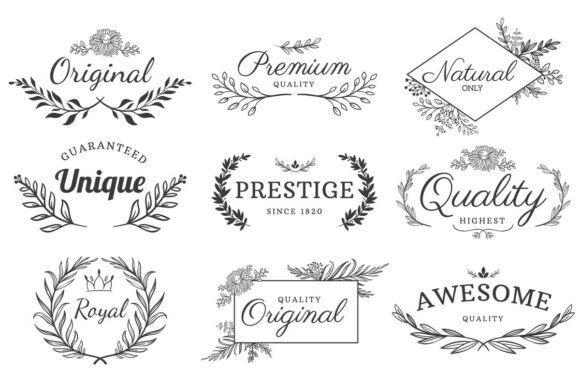
In the landscape of modern graphic design, the intersection of vintage aesthetics and digital efficiency creates a unique niche for assets like the Floral Ornament Label. Flowers and branch emblem collections. These are not merely decorative images; they are functional components that bridge the gap between raw creative concepts and polished, market-ready deliverables. For professionals ranging from wedding illustrators to small business owners packaging artisanal goods, understanding how to integrate these vector templates into a broader workflow is essential for maintaining consistency and quality.
The core value of a decorative leaf frame and ornamental framed text vector template set lies in its versatility. Unlike raster images that degrade when resized, vector-based floral ornaments allow for infinite scalability without loss of fidelity. This technical characteristic dictates where these assets fit in a project timeline. They are most effective when introduced during the structural planning phase of a design, rather than as an afterthought. By treating the floral ornament label as a foundational element, designers can build layouts that accommodate organic shapes from the start, ensuring that text legibility and visual balance are preserved throughout the iteration process.
Strategic Placement in the Creative Process
When approaching a new project, such as a wedding invitation suite or a line of botanical skincare products, the decision to use a flowers and branches emblem should happen before the first pixel is placed. This pre-production planning ensures that the chosen ornament aligns with the brand identity or event theme. For instance, a delicate, fine-line leaf branch emblem suits a minimalist wedding aesthetic, while a dense, baroque floral frame might better serve a luxury perfume label. Integrating these elements early prevents the common pitfall of forcing a decoration onto a completed layout, which often results in cramped text or unbalanced white space.
During the execution phase, these assets function as modular building blocks. A well-constructed ornamental framed text vector template acts as a container for variable data. In a workflow involving multiple SKUs or personalized invitations, the frame remains constant while the interior text changes. This separation of static decoration and dynamic content streamlines the production process. Designers can lock the floral layers in their software, preventing accidental shifts while focusing on typography and color grading. This method significantly reduces error rates and speeds up the time from concept to final proof.
Post-production also benefits from the use of high-quality vector florals. Because these files are resolution-independent, they future-proof the asset library. A label designed today for a business card can be scaled up tomorrow for a storefront sign without needing to recreate the artwork. This long-term usability is a critical factor for entrepreneurs and marketers who need to maintain brand consistency across various touchpoints over years of operation.
Compatibility and Technical Integration
The smooth integration of a Floral Ornament Label. Flowers and branch set depends heavily on file compatibility and organization. Most professional workflows rely on industry-standard software such as Adobe Illustrator, CorelDRAW, or Affinity Designer. When selecting a template set, it is vital to verify that the file formats (typically EPS, SVG, or AI) are compatible with your specific toolset. Vector files that rely on proprietary effects or outdated plug-ins can cause rendering issues, breaking the workflow and necessitating time-consuming fixes.
Organization is another pillar of efficient implementation. A comprehensive set often includes dozens of variations—corners, borders, full frames, and standalone sprigs. Without a structured filing system, locating the perfect leaf branch emblem can become a bottleneck. Professionals should categorize these assets by style (e.g., Art Nouveau, Victorian, Modern Minimalist) and complexity. Tagging files with metadata related to their usage context, such as "wedding," "packaging," or "header," allows for rapid retrieval during high-pressure deadlines. This level of preparation transforms a chaotic asset folder into a reliable resource library.
Furthermore, consider how these ornaments interact with other design elements. A dense floral frame may compete with complex background textures or busy photography. In such cases, the workflow must include a step for simplifying the composition, perhaps by reducing the opacity of the ornament or converting it to a single-color silhouette to ensure it supports rather than overwhelms the primary message. Testing the ornament against different background colors early in the process helps identify contrast issues before they reach the client or print stage.
Practical Applications Across Industries
The application of flowers and branches emblems extends far beyond traditional stationery. In the realm of e-commerce, product packaging relies heavily on visual cues to convey quality and origin. A decorative leaf frame around a "Organic" or "Handmade" badge instantly communicates natural ingredients and artisanal care. For marketers, these elements can be used to create social media graphics that stand out in a feed dominated by flat, corporate designs. The organic curves of floral ornaments draw the eye and add a touch of elegance that generic shapes cannot replicate.
Educators and publishers also find value in these assets when creating worksheets, certificates, or book covers. The psychological impact of floral imagery often evokes feelings of growth, beauty, and tranquility, which can enhance the reception of educational materials. When integrating these into a publishing workflow, consistency is key. Using the same family of floral ornaments across a series of textbooks or a curriculum creates a cohesive visual identity that aids in brand recognition for the institution.
- Wedding Industry: Use ornamental frames for save-the-dates, menus, and place cards to establish a unified theme.
- Food and Beverage: Apply leaf branch emblems to jar labels, bottle necks, and restaurant menus to suggest freshness.
- Beauty and Wellness: Incorporate delicate floral vectors into spa brochures and product packaging to imply gentleness and nature.
- Corporate Branding: Utilize simplified botanical icons for logos and letterheads to add a human touch to professional communications.
Quality Control and Customization
While template sets offer convenience, they require a degree of customization to avoid a generic look. A crucial part of the workflow involves modifying the base Floral Ornament Label. Flowers and elements to suit specific needs. This might involve adjusting the stroke weight to match existing brand guidelines, changing the color palette to align with seasonal trends, or combining parts of different emblems to create a unique hybrid design. However, caution is necessary; over-editing can distort the vector paths, leading to jagged edges or uneven lines upon printing.
Quality control checks should focus on the integrity of the vector paths. Before sending a file to print or exporting it for web use, zoom in to inspect the anchor points of the floral details. Ensure there are no stray points or open paths that could cause rendering errors. Additionally, verify that the text within the ornamental framed text vector template has sufficient breathing room. Text that touches the inner edge of a floral frame often appears cluttered and difficult to read. Adjusting the kerning or scaling the frame slightly can make a significant difference in the final polish.
Consistency across mediums is another quality metric. An ornament that looks crisp on a screen may lose detail when printed on textured paper or embossed. Prototyping is essential. Print a sample on the actual material intended for the final product to see how the ink interacts with the substrate. Fine lines in a leaf branch emblem might fill in if the resolution is too low or the paper too absorbent. Anticipating these physical constraints during the digital design phase saves resources and ensures the final output meets professional standards.
Maximizing Efficiency in Long-Term Projects
For freelancers and agencies managing multiple clients, the ability to reuse and adapt assets is a major efficiency driver. Building a master library of preferred flowers and branches emblems allows for rapid prototyping. When a new client requests a botanical theme, the designer can pull from this curated collection, knowing exactly how each file behaves in their workflow. This reduces the time spent searching for assets and increases the time available for strategic creative thinking.
Moreover, these assets facilitate collaboration. When working with a team, having a standardized set of approved floral ornaments ensures that all members produce work that adheres to the project's visual language. This reduces the need for extensive revisions and keeps the project moving forward smoothly. Clear documentation on how to use these templates—including preferred color codes and minimum size requirements—further enhances team productivity.
Ultimately, the successful use of a Floral Ornament Label. Flowers and decorative set is about more than just aesthetics; it is about workflow optimization. By treating these vector templates as integral tools rather than mere decorations, creators can enhance their productivity, maintain high-quality standards, and deliver visually compelling results that resonate with their audience. Whether framing a wedding vow or labeling a small-batch jam, the right floral ornament provides the structure needed to elevate the content within.